Gen Z Slang · praise, sports
What Does 'goat' Mean?
Mainstream
“I may have spent a little too much time trying to understand your Gen Z language… b mm From”
via timesofindia.indiatimes.com
By the numbers
GenZHype Trend Engine · YouTube reach + Wiktionary lookupsgoat is steady right now: it scores 82/100 on the GenZHype trend index, with roughly 523M YouTube views, and about 45 Wiktionary lookups a day, as of Sep 24, 2026 (GenZHype Trend Engine).
Live trend read for “goat”: combined YouTube reach + dictionary lookups, scored by a Mann-Kendall trend test on the daily series, as of Sep 24, 2026. Built in-house, refreshed nightly.
See it in action
Video: English slang - “GOAT” 🐐, embedded from its original platform.
What it means
In contemporary slang, 'GOAT' is overwhelmingly used as an acronym for 'Greatest Of All Time.' It's a powerful compliment, reserved for individuals or things that are considered unparalleled in their domain. This can apply to athletes, musicians, artists, or even inanimate objects that are perceived to be the absolute pinnacle of quality or achievement.
The term is often used with intense admiration and can be a subject of passionate debate, especially when fans argue who among their favorites deserves the GOAT title.
While the literal animal 'goat' has various other meanings, including a type of ruminant of the genus Capra, its meat, a lecherous man, a scapegoat, a specific car model (Pontiac GTO), a person difficult for speech recognition, a fool or object of ridicule, or a specific blocking tactic in sports, these older definitions are rarely the intended meaning when the term is used in modern internet slang.
The context almost always points to the 'Greatest Of All Time' interpretation. Beyond just naming someone the best, 'GOAT' can also be used to describe an action or a moment that exemplifies peak performance. For instance, a spectacular play in a game or a flawlessly executed artistic piece might be described as 'GOAT' to emphasize its exceptional quality.
The term's versatility allows it to be applied to a wide range of subjects, from a legendary athlete to an exceptionally well-made piece of technology or even a perfectly executed recipe, signifying the absolute zenith of excellence in that particular context.
The slang term 'GOAT' signifies the highest possible level of achievement or skill, denoting someone or something as the 'Greatest Of All Time.' This designation is not given lightly and is typically reserved for those who have demonstrably outperformed all others in their field, often over an extended period. The term functions as a superlative, a concise way to express ultimate admiration and recognition of unparalleled talent or accomplishment.
Its usage implies a consensus, or at least a strong argument, that the subject in question has reached a level that is unlikely to be surpassed.
While the word 'goat' itself has a long history, dating back to the domestication of the animal around 10,000 years ago in Iran, and has accrued various idiomatic meanings over centuries (such as a lecherous man or a scapegoat), the modern slang usage is almost exclusively tied to the acronym 'Greatest Of All Time.' This contemporary meaning is distinct from its older, literal, or figurative definitions, though the animal's historical significance as one of the first domesticated species (Source 1) provides a backdrop of enduring presence and utility, which perhaps lends a certain gravitas to its modern superlative designation.
The term is frequently employed in informal settings, particularly online, to settle debates or to emphatically praise an individual's exceptional prowess. It can also be used to describe an object or creation that is considered perfect or flawless in its execution, representing the pinnacle of its kind. The intensity of the compliment suggests a definitive and final judgment of supreme quality, setting the subject apart from all others.
The contemporary slang meaning of 'GOAT' is almost exclusively an acronym for 'Greatest Of All Time.' This phrase is used to designate an individual, group, or even an object as being the absolute best in their respective field or category, surpassing all others in skill, achievement, or quality.
It's a powerful term of praise, often used in contexts of intense admiration and debate, particularly within sports, music, and other competitive arenas. The term is meant to convey a definitive and ultimate level of excellence, suggesting that the subject has reached a peak that is unmatched and potentially unmatchable.
While the literal animal 'goat' has a long history of domestication and various symbolic meanings (such as being a scapegoat or a lecherous figure), these older connotations are largely disregarded in modern slang usage. The acronymic interpretation has become so dominant that the literal animal is rarely the intended reference when 'GOAT' is used in informal, contemporary discourse.
The term can be applied to a wide array of subjects, from legendary athletes like Muhammad Ali or Michael Jordan to iconic musicians, groundbreaking artists, or even exceptionally well-performing products. The emphasis is always on supreme, unparalleled achievement and recognition. The term is frequently used to settle arguments or to emphatically declare someone or something as the undisputed best, often sparking passionate discussions among fans and enthusiasts.
Its conciseness and impact make it a popular choice for expressing ultimate praise in a quick and memorable way, especially in digital communication.
The slang term 'GOAT' is an acronym for 'Greatest Of All Time.' It is used to denote someone or something that is considered the absolute best in their field, surpassing all others in skill, achievement, or quality. This designation is typically reserved for individuals who have reached the pinnacle of their profession and whose accomplishments are widely recognized as unparalleled.
The term is often used in sports to debate who among legendary athletes holds the title of the greatest, but its application has expanded to other domains such as music, art, and even everyday life. It serves as a powerful compliment, expressing intense admiration and a definitive judgment of supreme excellence.
While the word 'goat' itself has a long history and various literal and figurative meanings (e.g., the domestic animal, a lecherous man, a scapegoat), the modern slang usage is almost exclusively the acronym. The context in which 'GOAT' is used almost invariably points to the 'Greatest Of All Time' interpretation, distinguishing it from older meanings.
The term is frequently employed in informal discussions, online forums, and social media to express strong opinions and to celebrate exceptional talent. It can also be used to describe an action or moment that exemplifies peak performance, such as a spectacular play in a game or a flawless artistic creation.
The term's popularity is fueled by its ability to concisely convey a high level of praise and to engage in passionate debates about who truly deserves the title of 'GOAT'. [1][2][3][4][5][6]

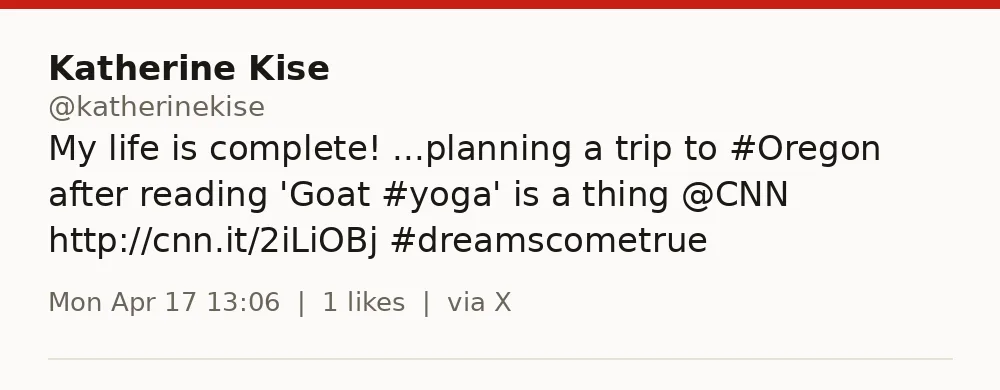
The receipt
Original post, embedded from Twitter, linked and credited. Visuals on this page are shown for commentary and identification.
The receipts
Documented, dated uses of “goat” — each quote is verbatim from the linked source.
“Hariharan attempts to understand Gen Z language and slang like 'slay', 'no cap' and 'GOAT' in fun video, netizens praise his efforts : 'I may have spent a little too much time, slowly getting there' - WATCH Sign InTOI Ne…”
“A funny thing that happens sometimes is when words — especially slang terms — get overused to the point that they lose their meaning. One recent example of this phenomenon might be the word “woke,” which has been run int…”
“What does 'G.O.A.T.' mean? Often behind a hashtag, it's a true compliment. USA TODAYCommunication is constantly evolving and adapting thanks to the digital platforms we use every day. Sometimes, scrolling through your f…”
“Hariharan attempts to understand Gen Z language and slang like 'slay', 'no cap' and 'GOAT' in fun video, netizens praise his efforts : 'I may have spent a little too much time, slowly getting there' - WATCH Sign InTOI Ne…”
“A funny thing that happens sometimes is when words — especially slang terms — get overused to the point that they lose their meaning. One recent example of this phenomenon might be the word “woke,” which has been run int…”
“What does 'G.O.A.T.' mean? Often behind a hashtag, it's a true compliment. USA TODAYCommunication is constantly evolving and adapting thanks to the digital platforms we use every day. Sometimes, scrolling through your f…”
Every quote above passed the same verification gate this site publishes under: real source, real date, copied verbatim. See the editorial policy.
Why it's everywhere
The term 'GOAT' remains highly relevant due to its concise and emphatic nature. In the fast-paced world of social media and online discussions, acronyms like GOAT allow for quick expression of strong opinions and praise. Its widespread use in sports, which has a massive global following, has cemented its place in everyday language, extending far beyond athletic circles to encompass any field where excellence is recognized.
The term's ability to spark passionate debate and friendly arguments about who truly deserves the title also contributes to its continued popularity, as it encourages engagement and discussion. Furthermore, its application to various domains beyond sports, such as music, art, and even everyday achievements, broadens its appeal and keeps it relevant across different communities.
The inherent superlatives it carries make it a potent tool for expressing admiration and establishing definitive rankings, ensuring its continued use in conversations about excellence. The term's simplicity and memorability also contribute to its enduring presence in popular culture.
The enduring trendiness of 'GOAT' stems from its effectiveness as a concise and powerful descriptor of ultimate excellence. In an era dominated by rapid online communication and social media, the acronym provides an efficient way to convey high praise and to participate in passionate debates about who or what is the best.
Its deep roots in sports culture, a domain with a vast and engaged global audience, have ensured its widespread recognition and adoption. As sports discussions frequently involve crowning legends, 'GOAT' has become an indispensable term for fans and analysts alike.
Moreover, the term's versatility has allowed it to transcend its sporting origins, becoming applicable to any field where exceptional talent or quality is recognized, from music and film to technology and culinary arts. This adaptability ensures its continued relevance across diverse communities and interests.
The term also thrives on the inherent human desire to identify and celebrate the best, fueling ongoing discussions and arguments that keep 'GOAT' at the forefront of popular discourse. Its ability to provoke strong opinions and encourage lively debate further solidifies its status as a trending term.
The term 'GOAT' continues to trend because it serves as a highly effective and universally understood shorthand for 'Greatest Of All Time.' In the fast-paced environment of social media and digital communication, its conciseness allows for rapid expression of strong opinions and admiration.
Its deep entrenchment in sports culture, a global phenomenon, has propelled its widespread adoption, making it a familiar term even to those outside of dedicated fan bases. The term's ability to ignite passionate debates and friendly rivalries about who truly deserves the title of 'GOAT' keeps it relevant and engaging. People enjoy arguing for their favorites and defending their choices, which naturally keeps the term in circulation.
Furthermore, the application of 'GOAT' has expanded beyond sports to encompass any domain where excellence is recognized, from music and art to technology and even everyday achievements. This versatility ensures that the term remains applicable and resonant across a wide range of interests and communities.
Its power lies in its ability to definitively label something as the pinnacle of quality or achievement, making it a compelling descriptor that continues to capture the public imagination.
The continued relevance and trending status of 'GOAT' can be attributed to its potent combination of conciseness, impact, and broad applicability. In the digital age, where information is consumed rapidly, acronyms like 'GOAT' offer an efficient way to express strong sentiments of admiration. Its deep roots in sports culture, a domain with immense global reach and passionate followings, have solidified its place in everyday language.
The term is not merely descriptive; it actively fuels discussion and debate, as fans and critics alike engage in passionate arguments over who truly embodies the 'Greatest Of All Time.' This inherent capacity to spark conversation ensures its ongoing visibility. Moreover, the term's versatility has allowed it to transcend its original context, being applied to individuals, products, or achievements in music, art, science, and beyond.
This adaptability ensures that 'GOAT' remains a relevant descriptor across a wide spectrum of interests and communities. Its power to definitively declare something as the ultimate best makes it a compelling and enduring term in popular culture.

How to use it
Register is informal; generally not cringe unless overused ironically.
- “That dunk was absolutely GOAT!”Discussing a basketball game
- “She's the GOAT of baking; her cakes are legendary.”Talking about a friend's skills
- “People will be debating if he's the GOAT for generations.”In a sports forum
- “This new album from my favorite artist is pure GOAT.”Sharing music opinions online
- “Cristiano is the GOAT of football, no question.”In a discussion about soccer players
- “Those new noise-canceling headphones? They're G.o.a.t.”Reviewing a product
Frequently asked
Is 'GOAT' always an acronym?
In modern slang, 'GOAT' almost exclusively refers to the acronym 'Greatest Of All Time.' Older, literal meanings related to the animal are rarely intended in casual conversation or online.
Can 'GOAT' be used for things, not just people?
Yes, 'GOAT' can be used to describe anything considered the absolute best, like a song, a movie, a piece of technology, or even a food item.
Is it okay to call someone the GOAT?
Yes, calling someone the GOAT is a high compliment. It signifies that you believe they are the best in their field.
Related slang (2)
More slang (6)
Sources (6)
- en.wiktionary.org — Wiktionary: goat
- urbandictionary.com — Urban Dictionary: goat
- timesofindia.indiatimes.com — Hariharan attempts to understand Gen Z language and slang like 'slay', 'no cap' and 'GOAT' in fun video, netizens praise his efforts : 'I may have spent a little too much time, slowly getting there' -
- uproxx.com — Lil Baby Shocked Rylo Rodriguez Didn't Know 'GOAT' Meaning
- columbiatribune.com — 'G.O.A.T.' meaning: How to use the slang in conversation.
- spectator.com — Why is sport so obsessed with Goats? | The Spectator