Gen Z Slang · tech slang
What Does 'clanker' Mean?
Mainstream
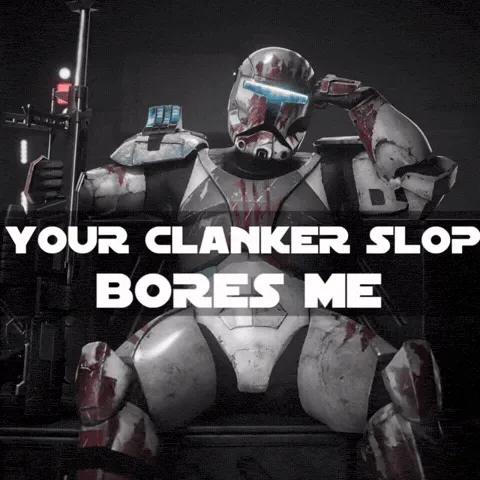
Via GIPHY (@dimensionalxstudios)
See it in action
Video: What Does Clankers Mean?, embedded from its original platform.
What it means
Clanker functions as a catch-all pejorative for any artificial intelligence system that feels intrusive, incompetent, or dehumanizing. In its dominant 2025-2026 usage, the word targets the *presence* of AI rather than a specific failure: a delivery robot blocking a sidewalk, a chatbot hallucinating facts, an automated phone tree that refuses to transfer to a human, or a generative-image model trained on unconsented artwork.
The tone ranges from playful exasperation, kids shouting "Keep it moving, clanker!" at a struggling golf cart or a glitchy NPC in Fortnite, to genuine hostility, as in TikTok skits that stage segregated drinking fountains labeled "clankers only" or a father rejecting his daughter's robot boyfriend until he learns it's Wall-E.
That latter meme, captioned "Only Good Clanker," was explicitly read by linguist Adam Aleksic as a parody of racial gatekeeping, illustrating how the term can carry charged undertones even when users claim they're just joking about machines.
Beyond the core sense of "robot/AI," the word has stretched into adjacent niches. Wiktionary flags a "hot" provisional sense for *people* who lean heavily on generative AI, "Education is getting overtaken by clankers", turning the insult outward onto human enablers. A third, older British sense meaning "a fib" or "a lie" persists in dialect but is unrelated to the current surge.
The Star Wars lineage gives the term a built-in sci-fi flavor: clone troopers used it for the B1/B2 battle droids' metallic clatter, and the franchise's lore even places the slur in a historical discrimination arc where droids are refused service in cantinas.
That fictional backdrop makes the leap to real-world AI backlash feel narratively satisfying, which helps explain why clanker beat out rivals like "wireback" or "skinjob", it's intuitive, onomatopoeic, and already meme-legible to anyone who grew up on Clone Wars clips.
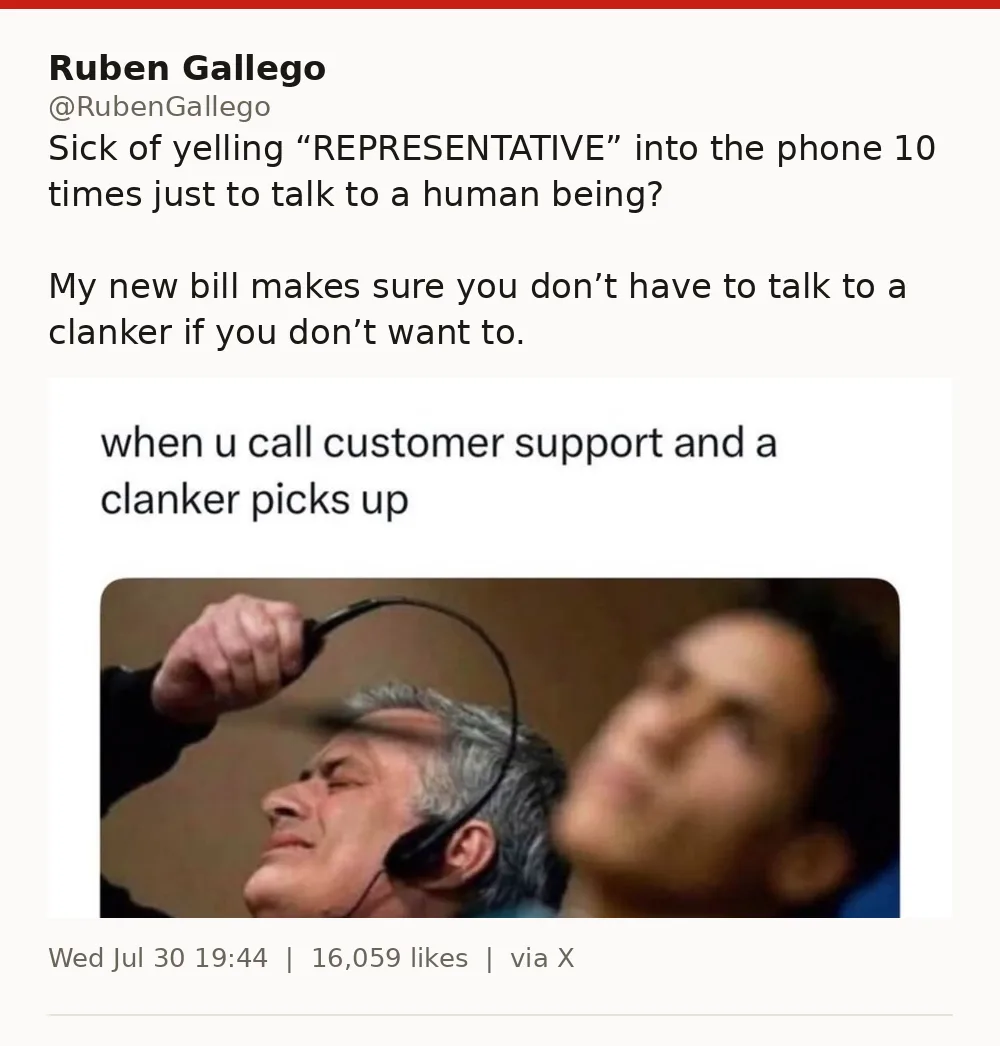
Crucially, clanker is not synonymous with "AI slop" (low-quality AI output). Slop critiques the *product*; clanker demeans the *system* and, by extension, the corporations pushing it. When Senator Ruben Gallego tweeted in June 2025 that his bill "makes sure you don't have to talk to a clanker if you don't want to," he was targeting the *deployment* of undisclosed voice agents in call centers, not a specific bad answer.
That political adoption signals the term has escaped pure meme status and become a rhetorical tool in policy debates over automation, labor displacement, and consent. For Gen Z, using clanker signals both digital nativity, you know the Star Wars reference, and a skeptical stance toward the AI hype cycle: you've seen the hallucinations, you've read the energy-cost reports, and you're not impressed. [1][2][3][4][5][6]
The receipt
Original post, embedded from Twitter, linked and credited. Visuals on this page are shown for commentary and identification.
The receipts
Documented, dated uses of “clanker”: each quote is verbatim from the linked source.
“I heard her say, 'Keep it moving, clanker!'”
“One tongue-in-cheek video illustrates a parent telling their child, 'we don't speak to them,' and another video shows a human telling a robot, 'get this dirty clanker out of here!'”
Seen in use
People using “clanker” in their own posts, each linked to the post itself. These are examples of use, not sources.
“Only Good Clanker.”
“My first clanker coworker, I stock shelves overnight and last month they 'hired' this robot that does the cart runs and fetches pallets.”
Every quote above passed the same verification gate this site publishes under: real source, real date, copied verbatim. See the editorial policy.
Why it's everywhere
The explosion of clanker in summer 2025 maps directly onto three converging anxieties. First, direct physical encounters with autonomous machines, sidewalk delivery bots, warehouse pallet-runners, hotel service robots, turned abstract "AI takeover" talk into daily friction points. Pedestrians and cyclists complained about mobility hazards; overnight stockers like Reddit's u/No_Resident_4287 posted about a "clanker coworker" that fetched pallets after they'd waited nine months for box-cutter certification.
Second, the generative-AI hype cycle peaked: ChatGPT hallucinations, AI girlfriend apps, and a chatbot allegedly telling a teen to kill himself fueled a narrative that these systems are simultaneously incompetent and dangerous. Teens like Allie (13) and Zoe (13) told Yahoo they restrict AI use to forced school projects, citing environmental waste and ethical red lines.
Third, corporate advocacy from figures like Elon Musk and Sam Altman, plus Amazon's humanoid-robot rollout, framed automation as inevitable, triggering a cultural immune response. A 2023 Gartner survey showed 64% of customers prefer companies avoid AI in service; a 2026 Elon University study found 83% of U.S. adults expect net job loss. Clanker became the linguistic vessel for that collective "no thanks."
Platform dynamics accelerated the spread. TikTok and Instagram Reels served up hundreds of millions of views on clanker skits, dystopian roleplays, "meet the robot boyfriend" parodies, kids roasting malfunctioning gadgets, because the term's two syllables and hard K make it punchy in caption text and voiceover.
The Star Wars origin gave creators a ready-made lore drop: "Clone troopers called droids clankers, now we call ChatGPT clankers." That intertextuality fuels engagement (explainers, reaction stitches, "did you know" videos) without requiring the audience to know the 2005 Republic Commando game. Meanwhile, the slur-adjacency debate, linguist Gaillynn Clements calling it a potential microaggression, Axios citing Geoffrey Nunberg to argue it's merely derogatory, generated a second wave of discourse content.
The result: a term that feels both insider (gaming/Star Wars literacy) and outsider-accessible (anyone who's yelled at a phone tree), locking it into mainstream slang rotation rather than burning out as a niche meme.
How to use it
Use clanker when you're venting about AI/robots, it's mainstream, not cringe, but avoid deploying it in formal writing or around people who might read the racial-slur-parallel discourse as intentional.
- “The automated checkout just froze again, stupid clanker ate my coupons.”Grocery store frustration with self-checkout kiosk
- “My manager wants the clanker to write the first draft of the press release; I'm just here to fix the hallucinations.”Workplace Slack channel discussing generative AI policy
- “TikTok POV: 2030 and there's a separate water fountain for clankers 💀”Dystopian humor skit caption on Instagram Reels
- “Senator's new bill lets you press zero to skip the clanker and reach a human, finally.”Political tweet thread about call-center disclosure legislation
- “Bro really brought a clanker to the LAN party and expected us to carry its power brick.”Discord voice chat joking about a teammate's AI coding assistant
- “Keep it moving, clanker!, my kid yelling at the Roomba stuck on a rug.”Family living room, playful domestic usage
Frequently asked
Is clanker a slur?
Linguists are split. Some argue it functions like a slur because it anthropomorphizes AI and echoes racial gatekeeping memes; others say it's merely derogatory since robots aren't a protected class. In practice, most Gen Z users treat it as a venting insult, not a hate term.
Where did clanker come from originally?
The word appears in a 1958 William Tenn article and was adopted by Star Wars for clone-trooper slang against battle droids in the 2005 game Republic Commando and the 2008 Clone Wars series. The current anti-AI sense exploded from that meme lineage in summer 2025.
Can you call a person a clanker?
Emerging usage on Wiktionary flags a provisional sense for 'a person who uses automated technology or generative AI heavily' (e.g., 'Education is getting overtaken by clankers'), but the dominant meaning still targets the AI system itself.
Why did clanker beat out 'wireback' or 'gearhead'?
Clanker is onomatopoeic, two syllables, and carries ready-made Star Wars cultural capital, clone troopers, battle droids, cantina discrimination lore, making it instantly legible and meme-ready across TikTok, Reels, and gaming chat.
Is clanker cringe now?
As of late 2026 it's mainstream: used by kids, senators, and linguists alike. It hasn't hit the 'only adults say it' cringe phase, though the slur-parallel discourse makes some users self-aware about deployment.
Related slang (5)
More slang (6)
Sources (6)
- ca.news.yahoo.com — Is 'clanker' an appropriate slang for AI? These linguists weigh in - Yahoo News Canada
- aol.com — Is 'clanker' an appropriate slang for AI? These linguists weigh in - AOL
- ca.news.yahoo.com — What is a Clanker and why are people on social media using it as an anti-AI slang? - Yahoo News Canada
- yahoo.com — What's a 'clanker'? We asked kids about the new slang young people are using.
- en.wikipedia.org — Wikipedia: Clanker
- en.wiktionary.org — Wiktionary: clanker