Gen Z Slang · gaming slang
What Does 'npc' Mean?
Mainstream
See it in action
Video: English Slang Word "NPC", embedded from its original platform.
What it means
In video-game terminology, NPC stands for non-playable character (or non-player character). It refers to any figure in a game world that the player does not control, including background townspeople, quest-givers, merchants, ambient animals, or even companion AI that follows a set script.
Sources note that NPCs can be richly written and essential to the story, or they can be simple, repetitive figures that walk in loops or stand idle until triggered, much like the townsfolk in Animal Crossing, the townies in The Sims, Navi in The Legend of Zelda, or the merchant in Resident Evil 4.
The same acronym has taken on a pejorative slang sense. When directed at a real-life person, NPC implies that the individual is irrelevant, boring, or lacking originality, someone who “just there” and operates on a default, predictable pattern, like a background character that repeats a set of actions.
Urban Dictionary definitions cited in the sources describe NPCs as “robotic,” “basic,” and “Someone that operates on a default, predictable pattern.” The term is also used in political or ideological discourse to accuse others of merely repeating programmed talking points, reflecting a simulation-hypothesis-flavored view of people who cannot think objectively.
Beyond the insult, some teens and young adults have reclaimed the label as a sign of self-awareness: recognizing that they may play a background role in others’ stories while still mattering in their own lives, as explained by visiting lecturer Benjamin Morse.
In this reclaimed use, calling oneself an NPC can be a joking acknowledgment of one’s place in a larger social “game,” emphasizing that even background characters have value and can be as important as the main players in today’s immersive games. [1][2][3][4][5]
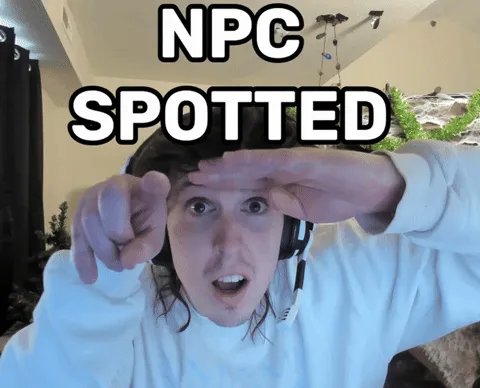
The receipt
Original post, embedded from Tiktok, linked and credited. Visuals on this page are shown for commentary and identification.
The receipts
Documented, dated uses of “npc”: each quote is verbatim from the linked source.
“You've told me that story 10 times before. Don't be an NPC”
“Got beef with an NPC?”
Seen in use
People using “npc” in their own posts, each linked to the post itself. These are examples of use, not sources.
“n the scene before the plot even starts. You try a party and you are looking at NPCs running outdated software. Insecurity, dopamine, fake confidence, the same five lines on repeat. You try a date and you do not see a pe…”
Every quote above passed the same verification gate this site publishes under: real source, real date, copied verbatim. See the editorial policy.
Why it's everywhere
The recent surge of NPC in everyday talk is driven by its spillover from gaming culture onto platforms like TikTok, where cosplay-and-skit videos that mimic NPC behavior and the NPC live-streaming trend have made the acronym widely recognizable. Creators such as TikToker Pinkydoll, who reportedly makes thousands of dollars per day by acting as an NPC and reacting to viewer gifts, have highlighted the trend’s visibility and earning potential.
Beyond meme formats, NPC functions as a concise way to critique conformity and lack of individuality, resonating with broader conversations about authenticity versus mainstream trends. Because it can be used both as an insult and as a self-aware acknowledgment of one’s place, the word carries layered meanings that keep it relevant across gaming, social-media, and youth-culture contexts.
Academic interest in the term has also grown; a Euronews report noted that English-language learners in the UK want teachers to explain slang like NPC, showing that the expression has moved from niche gaming forums into mainstream language-learning discussions.
How to use it
Used as a noun; can be teasing or self-reflective, but may be seen as harsh if directed at someone’s personality.
- “You've told me that story 10 times before. Don't be an NPC.”A teen calling out a friend who repeats the same anecdote.
- “That trend is so over, NPC.”Commenting that a viral meme or fashion is no longer fresh.
- “She’s such an NPC, she just nods along to whatever everyone else says.”Describing a coworker perceived as lacking original thought.
- “I love NPC streaming; watching someone act like a video-game character while reacting to gifts is oddly satisfying.”A viewer describing the appeal of TikTok NPC live-streams.
Frequently asked
Does NPC only refer to video-game characters?
No. While it originates as non-playable character in games, it is also widely used as slang to describe a person seen as boring, unoriginal, or merely following the crowd.
Is calling someone an NPC always insulting?
Not necessarily. Some teens use it self-reflectively to acknowledge they may play a background role in others’ stories while still valuing their own lives, though it can still be taken as a critique depending on tone and context.
How did NPC become popular on TikTok?
Through cosplay and skit videos that mimic NPC behavior, and especially through the NPC live-streaming trend where creators act like robotic game characters and earn money from viewer gifts.